"you can like the life you're livin' - you can live the life you like- you can even marry Harry and mess around with Ike" -Chicago
or something like that...
The lady in front of me shouts in delight for the taxi driver to turn up the music. She really likes the song, and is rockin' to the beats. She lifts her hands, bobs her head, clearly unconcerned what the rest of us passengers might be thinking. How unrepressed, how liberating, to witness such freedom of spirit!
To live the life you want takes a lot of courage. From a Western perspective, a person who is a product of social and educational systems designed for conformity and oppression, doing things out of the ordinary seems out of reach, or a goal to accomplish "someday," after going to college, finding a job and filling your mortgaged home with stuff, as the systems demand. It is amazing the repressive tone our culture takes on when compared to southern African culture, whether urban or rural. They encourage free expression where we stare and feel embarrassed if we see it out of context- at a music concert, for example, would be an appropriate place for expressing unabashed pleasure.
"Freedom from stuff" as a topic alone could fill pages; how fulfilling it is to have little, less to clean, less to move, and less to worry about people stealing. What I really want to talk about, though, is discovering my passions and purpose. I finally think I've done it.
For as long as I can remember, I have enjoyed art: drawing, painting, colors, shapes, light, both looking at and making it. Nature and I have always been close. I remember loving natural sciences and going to the zoo as a girl, and even entertained the idea of making a career as a marine biologist- that is, until I enrolled in my first biology course and quickly realized microsciences were not for me. Inheriting my mother's green thumb and joy for cultivating the earth, I guess I would consider myself more of a "naturalist" than a "scientist." In recent years, as an adult, I've developed a passion for food and cooking. Healthy, minimally processed, simple and delicious is the kind I love. There also exists my love for reading, quest for knowledge and understanding, and the career in library sciences. All these passions, so little time I have to pursue them; this was my dilemma before joining the Peace Corps.
The million dollar answer for the question, why did you not want to go job hunting after earning the masters' degree? is because information science is not msole passion. I do not desire to work in any library, no matter how great, for 40 hours of every precious week of my life. I have worked in kitchens, bakeries and restaurants and don't particularly want to do that again, either. Not all the time. I don't want to paint all the time either and try to earn my living selling my artwork. So, because I didn't know what to do, joining the Peace Corps seemed like a good idea. It was a vehicle to allow me the time to figure all this out; bide some time, let me travel, meet new people, challenge me in new ways. Little did I know that this experience would lead to me discovering my true purpose.
Amid the sea of self-help books about purpose, habits, missions and the like, this one washed up on my shore last week. I checked it out from the Kuruman public library after searching for books about business. I have been helping the youth in my village with their business ideas and was also considering learning more for my benefit. This little gem is called Authentic Business (2005), all about the integrity of purpose and passion you must have within your business. Not just acting ethically or how to write a business plan, but the author offers a paradigmatic shift when examining the discipline of businesses. The author, Neil Crofts, had dyslexia and never learned to write for content until after he left high school, which is amazing because he is a great writer. The book reminds me of another inspiring book I read called The War of Art by Steven Pressfield, talking about overcoming your creative battles. The similarities are that both authors have their priorities in line with ethically sound, humanitarian, sensible but profound ideas. Profit is not an authentic motivator for neither art nor business. Somewhat surprising to see printed in black and white on the page in front of me, but quite refreshing, nonetheless. One passage in particular had (has) me grinning from ear to ear, ready to shout with joy: (pp 29-30)
"What is your non-negotiable dream? So precious that, so far, you have told no one for fear of it being compromised. What is the purpose to which you would commit body and soul if only you were allowed? What is your purpose that is profound for you and positive for life on Earth?
Say it.
Write it down.
Discuss it with people. If your regular friends won't discuss it with you, find other friends to discuss it with you."
He has simply articulated, or more aptly, abstracted, what I have been unconsciously doing during the last year; asking and mulling over these questions. After one year of "new"s: continent, languages, places, faces, names, goals and dreams, I am ready to answer these questions!
When I am honest, as I must be, I do not want what I thought I did even 2 months ago, 6 months, or twelve. My life looks very different. I am excited to see where it leads.
Saturday, August 7, 2010

Sunday, July 18, 2010
Survival of the fittest- feeling the blahs
I came to the realization yesterday that i might have a parasite. I knew something was not right, but thought it might be the cold and wind, or post vacation blues.
i was helping take care of a sick friend who doesn't boil water, so maybe i picked something up there. It's really something that divides the worlds-development and basic sanitation. Clean water is something most people around the world do not have and we americans take for granted. I have lamented in a previous post that a majority of my time revolves around water, but for good reason. One careless time of not boiling and one contracts cholera, parasites or who knows what.
i stayed with some fellow american friends who experienced the same thing before. The anecdotal evidence out here in volunteer land is priceless. Never before would i put so much stock into something so un-scientific, but changing with the times must happen for survival of the fittest. I truly feel like i have morphed into another species sometimes.
i was helping take care of a sick friend who doesn't boil water, so maybe i picked something up there. It's really something that divides the worlds-development and basic sanitation. Clean water is something most people around the world do not have and we americans take for granted. I have lamented in a previous post that a majority of my time revolves around water, but for good reason. One careless time of not boiling and one contracts cholera, parasites or who knows what.
i stayed with some fellow american friends who experienced the same thing before. The anecdotal evidence out here in volunteer land is priceless. Never before would i put so much stock into something so un-scientific, but changing with the times must happen for survival of the fittest. I truly feel like i have morphed into another species sometimes.
Friday, July 2, 2010
On usefulness, or best use of skills and nuns
As a volunteer, i am frequently requested to help with a wide variety of tasks, about many of which i know little to nothing. When the opportunities arise for me to help in areas better aligned with my expertise, it has been a real joy. This past week, i was afforded several of these opportunities.
I was originally invited to serve as an information technology volunteer, and suppose that a good portion of my work does involve i.t., just not in the ways I expected. I assist another volunteer in making a monthly newsletter for all volunteers and staff in south africa, and the two of us, a few months ago, came us with the idea of having an i.t, workshop during the world cup school break (we get an extra week). Although the peace corps approved our idea, they said there was no money for food, lodging or travel, so we would have to arrange for these ourselves. Not to be dissuaded, my friend and drafted an itenerary of relevant topics, he wrote the proposal, found a venue, got some spouses to help with cooking, and away we went.
Three days were spent discussing best practices and advice for teaching computer literacy (that was me), cloning hard drives, virus and anti-virus, file sharing, among other things. I also helped cook on day 3, which was awesome. I adore cooking for people, and cooking WITH people is something i have learned to enjoy while i have been here. Taking it easy, better planning and timing, not taking it too seriously, and bonding time with different people was the highlight of the week.
The venue was the site where my friend and his wife stay during their service, and it happens to be at a catholic mission. The ladies stayed with the sisters in the convent, and they were super. Three of them come from ireland, and one is a local motswana. The fathers allowed us the use of the rectory for the kitchen space and utilities, and we had a great time there. It was so pleasant to be in an atmosphere of love and godliness all week. The grounds were full of flowers, trees, dogs and rabbits, and some lush mountains.
Wedged in a taxi like a tinned fish, i am now on my way home after a whirlwind three weeks of travel. It will be nice to be in one place for awhile, until the next time.
I was originally invited to serve as an information technology volunteer, and suppose that a good portion of my work does involve i.t., just not in the ways I expected. I assist another volunteer in making a monthly newsletter for all volunteers and staff in south africa, and the two of us, a few months ago, came us with the idea of having an i.t, workshop during the world cup school break (we get an extra week). Although the peace corps approved our idea, they said there was no money for food, lodging or travel, so we would have to arrange for these ourselves. Not to be dissuaded, my friend and drafted an itenerary of relevant topics, he wrote the proposal, found a venue, got some spouses to help with cooking, and away we went.
Three days were spent discussing best practices and advice for teaching computer literacy (that was me), cloning hard drives, virus and anti-virus, file sharing, among other things. I also helped cook on day 3, which was awesome. I adore cooking for people, and cooking WITH people is something i have learned to enjoy while i have been here. Taking it easy, better planning and timing, not taking it too seriously, and bonding time with different people was the highlight of the week.
The venue was the site where my friend and his wife stay during their service, and it happens to be at a catholic mission. The ladies stayed with the sisters in the convent, and they were super. Three of them come from ireland, and one is a local motswana. The fathers allowed us the use of the rectory for the kitchen space and utilities, and we had a great time there. It was so pleasant to be in an atmosphere of love and godliness all week. The grounds were full of flowers, trees, dogs and rabbits, and some lush mountains.
Wedged in a taxi like a tinned fish, i am now on my way home after a whirlwind three weeks of travel. It will be nice to be in one place for awhile, until the next time.
Thursday, June 17, 2010
The eclectic, dysfunctional but fun family vacation
Four peace corps volunteers and one visiting american head off into the wild blue yonder. Various roles include mom, dad, twin sisters and the little cousin. Nobody made definite plans and only two of us can drive. We rented a car and are backpacking. In south africa, there are tons of places, like youth hostels, that are cheap and all around the country.
 Our journey started in Pretoria, around 3 pm. When we finally converged and headed out, it was four or half four. We sat in bumper to bumper traffic for almost two hours in joburg. (Surprise) Our first destination was a little town nestled in the mountains just north of Lesotho called Clarens. We didn't arrive until half ten, and it was positively freezing. I think the temp, according to the thermometer in the car, was minus 7 c. Remember, nothing is insulated or heated in africa. Thank god i brought my sleeping bag. I also sleep fully clothed. So, i did not get frostbitten.
The next morning, i had the chance to view the gorgeous surrounds. Tall pine trees, even taller mountains, some teepees, it was like an american ski town without the snow or ski slopes. The town has art galleries, coffee shops and other specialty stores. The microbrewery was disappointing, but was a nice alternative to the (crappy) usual beer we drink.


 After Clarens, we headed toward Port Elizabeth, using our Coast to Coast backpackers guide to Southern Africa, and found this this strange and wonderful place that is called Nieu Bethesda (or New Bethesda, if you prefer English and not Afrikaans). In the Karoo (which was touched with SNOW on our first visit- apparently they haven't seen snow in over 20 years), New Bethesda reminds me of that town on 'Northern Exposure' in Alaska- one pub, run by a teddy-bear type, jovial fellow named Ian, a microbrewery with AMAZING ale, a Swiss transplant who runs the local backpackers, restaurant and gift shop selling items made by locals, donkey cart tour of town, and the famous Owl House. We actually liked this so much that we returned for another night on our way back from Port Elizabeth.
The other 4 family members had tickets to watch some World Cup action, but I was just along for the ride. I did, however, get sucked in to the fun, learned how soccer "works" and really enjoyed watching multiple games at pubs and restaurants. Several witnesses could tell you I could officially be described as a fan, according to my jumping up and down, booing, cheering, and overall "ke nako" feeling. Mzanzi! Even though Bafana Bafana didn't make it out of the 3rd round, I met some people from Chile and cheered the Chilean team, of course cheered for USA vs. Algeria, which was a totally exciting game.


 Port Elizabeth has been poo-pooed by several other volunteers who have previously visited, but i absolutely loved it. We stayed 3 nights, which was a goodly amount to preview what the city has to offer. The beaches are gorgeous, it's not nearly as big as Capetown but with some of the same beauty, has a much more laid-back vibe, and is actually called "The Friendly City" of South Africa. The art museum, which was conveniently located near the FIFA Fan Park, was filled with incredible modern art. Incredible! I wanted to take photos of everything, but the guard insisted I show him each photo (I think he just wanted to make sure I took a nice one, but it was still distracting) so I just snapped one of my favorite pieces. It is so incredible to see that South Africans are capable of producing creative works that rival those from any other nation. And are maybe even more provocative because of the racial tensions that accompany the history of this place.

 One day in P.E. we spent the day at Addo Elephant park and saw over 30 elephants. They were so close we could have probably touched them (with a long stick), and there is nothing more incredible than watching elephants that close! You can really see the different personalities, watch the babies play, see their massive hulk and strength, but they are also gentle as well. And those eyes...they really keep an eye on you. So curious!
 The last night of our journey, we stayed in this swanky "cottage" in Pretoria. The backpackers were all booked and overcharging out the wazoo, so someone hooked us up with another place. Chandeliers, individual bathrobes, gourmet breakfast, terrace, veranda, granite countertops in the kitchen...ahh. Who says the life of a volunteer must be suffering? We cooked mushroom risotto, shared sparkling wine, and basked in the glow of USA's win over Algeria, and I was giddy 'cause Bill Clinton was in Pretoria watching the game at the same time I was. Who knew?
 One of my proudest moments was teaching my young friend how to drive a stick shift- first in Borakalelo game reserve, where we saw giraffe, wildebeast, tons of birds and bock, zebra, warthogs and some squirrels- then on the way to her village. There is no better compliment than when someone says you are a great teacher, and you can watch the confidence level and skill rise.

The next morning, i had the chance to view the gorgeous surrounds. Tall pine trees, even taller mountains, some teepees, it was like an american ski town without the snow or ski slopes. The town has art galleries, coffee shops and other specialty stores. The microbrewery was disappointing, but was a nice alternative to the (crappy) usual beer we drink.


The other 4 family members had tickets to watch some World Cup action, but I was just along for the ride. I did, however, get sucked in to the fun, learned how soccer "works" and really enjoyed watching multiple games at pubs and restaurants. Several witnesses could tell you I could officially be described as a fan, according to my jumping up and down, booing, cheering, and overall "ke nako" feeling. Mzanzi! Even though Bafana Bafana didn't make it out of the 3rd round, I met some people from Chile and cheered the Chilean team, of course cheered for USA vs. Algeria, which was a totally exciting game.


Friday, June 11, 2010
Cultures colliding celebration
I serve two villages, which are about 7 k apart from each other. I live in one and walk to the other. Although these communities are close to each other in distance, they might as well be worlds apart, in some ways.
One barrier that prevents collaboration is lack of transportation. Most people use donkey cart, bus or local taxi for travel, as owning a vehicle is too expensive. There is almost zero opportunity for employment in each place, and many are pensioners or young school children. For example, in the village where i live, there is one primary school, housing grades 1-7 with just over one hundred total learners, one bottle store (with a jukebox, which is technically not allowed, so don't tell) where beer is sold, one general store type shop run by bangladeshis, and one preschool. And houses, farm animals and some shrubby trees. Anything that happens takes place at the school. This leads to my next point, that none of the school teachers live in the communities where they teach. The government has set up the system in this way. Lack of integration between the major community centre and its leaders is built into the rural education system. Thirdly, the apathy that comes from a culture of poverty rears its ugly head around every turn. Lastly, one unique challenge is the rapidly approaching retirement of one of the school principals, from whom the tone of everything is set, and she is not ashamed nor quiet about her readiness to exit.
In a previous attempt to join these schoolteachers and principals (community leaders) together, i invited another volunteer to come and help me facilitate a workshop for the group. The workshop was great, but only the hosting school's teachers were in attendance. I can't remember the reason the others didn't come, but the following week, they asked me to give them the same workshop. I did not, and explained to them why. There were no hard feelings, and there are so many weekly fires to put out, the topic was quickly forgotten.
The second attempt occurred when we hosted a workshop for all interested volunteers, their principals and counterparts about libraries. That principal again had an excuse why she could not make it. Not to be deterred, i had the idea to host a party, in my home, for both schools, including non-teaching staff and the parents groups. Everybody loves food, and an excuse to have fun, right? The idea came to me after several months of feeling like i needed to do something about the situation, but not knowing exactly how to proceed. I pitched the idea to the reluctant principal first, to give her the opportunity to help me choose an appropriate date and time that would work for the end of the term. To my surprise, she was excited and did just that, help me plan.

With logistics taken care of, i started menu planning. There might be 25 people attending, so what could i make using my limited resources? This is one of my favorite parts of being a hostess. The more challenges, the better; stress brings creativity to a shiny apple glow. I utilized a recipe my sister loves but i have only used since coming to south africa, the no-bake cookies one from the peace corps cookbook. South africans have major sweet teeth, so i knew that would be a hit. I made one batch with cocoa and dessicated coconut, and the other with only peanut butter. For the savory treat, i made martha stewart's delicious egg salad recipe for tea sandwiches. The tea was inspired by something my mom used to drink called 'constant comment.' Water steeped with orange peel, clove and black tea. A friend of mine owns a shop and donated the bread, spices and cocoa for me. Menu planned, shopping done, house cleaned, party time!


I recieved hugs, help with dishes, requests for the next party, songs of thanks and a really nice speech and prayer, led by my wonderful, enlightened principal. It was truly an event to remember.


One barrier that prevents collaboration is lack of transportation. Most people use donkey cart, bus or local taxi for travel, as owning a vehicle is too expensive. There is almost zero opportunity for employment in each place, and many are pensioners or young school children. For example, in the village where i live, there is one primary school, housing grades 1-7 with just over one hundred total learners, one bottle store (with a jukebox, which is technically not allowed, so don't tell) where beer is sold, one general store type shop run by bangladeshis, and one preschool. And houses, farm animals and some shrubby trees. Anything that happens takes place at the school. This leads to my next point, that none of the school teachers live in the communities where they teach. The government has set up the system in this way. Lack of integration between the major community centre and its leaders is built into the rural education system. Thirdly, the apathy that comes from a culture of poverty rears its ugly head around every turn. Lastly, one unique challenge is the rapidly approaching retirement of one of the school principals, from whom the tone of everything is set, and she is not ashamed nor quiet about her readiness to exit.
In a previous attempt to join these schoolteachers and principals (community leaders) together, i invited another volunteer to come and help me facilitate a workshop for the group. The workshop was great, but only the hosting school's teachers were in attendance. I can't remember the reason the others didn't come, but the following week, they asked me to give them the same workshop. I did not, and explained to them why. There were no hard feelings, and there are so many weekly fires to put out, the topic was quickly forgotten.
The second attempt occurred when we hosted a workshop for all interested volunteers, their principals and counterparts about libraries. That principal again had an excuse why she could not make it. Not to be deterred, i had the idea to host a party, in my home, for both schools, including non-teaching staff and the parents groups. Everybody loves food, and an excuse to have fun, right? The idea came to me after several months of feeling like i needed to do something about the situation, but not knowing exactly how to proceed. I pitched the idea to the reluctant principal first, to give her the opportunity to help me choose an appropriate date and time that would work for the end of the term. To my surprise, she was excited and did just that, help me plan.

(Ausi: SGB member, me: volunteer, Mmoloki: General Worker, Keitumetse: Typist)
With logistics taken care of, i started menu planning. There might be 25 people attending, so what could i make using my limited resources? This is one of my favorite parts of being a hostess. The more challenges, the better; stress brings creativity to a shiny apple glow. I utilized a recipe my sister loves but i have only used since coming to south africa, the no-bake cookies one from the peace corps cookbook. South africans have major sweet teeth, so i knew that would be a hit. I made one batch with cocoa and dessicated coconut, and the other with only peanut butter. For the savory treat, i made martha stewart's delicious egg salad recipe for tea sandwiches. The tea was inspired by something my mom used to drink called 'constant comment.' Water steeped with orange peel, clove and black tea. A friend of mine owns a shop and donated the bread, spices and cocoa for me. Menu planned, shopping done, house cleaned, party time!

(Kebo: Principal, me: volunteer)
At first, i was concerned that word of my party had spread throughout the land, and EVERYBODY and their grandmother and dog would come. What would i feed them, where would they sit? After half an hour after the designated party time had passed, i began to wonder if ANYBODY would come. True to south african form, one hour late, mostly everyone i invited arrived (except the other principal- she had an appointment with a doctor, no worries). I played johnny cash's greatest hits on my ipod docking station, and finished the sandwiches while everybody mingled and had tea and cookies. I was so happy to see both communities represented and enjoying themselves! My enlightened principal says, 'now that you have us here together, say something.' i love this part, because it is always inevitable. I never say very much, but always make it meaningful. "somebody asked me the other day if i was going home for the long school break. I looked at him and said. 'what do you mean? I am home!' i want to thank you for making me feel so welcome, for working together, sharing food, songs, and cultures. Here's to another year of working together!"
(Mma Sebusho and Rra Sedumedi, SGB members)
I recieved hugs, help with dishes, requests for the next party, songs of thanks and a really nice speech and prayer, led by my wonderful, enlightened principal. It was truly an event to remember.

(Ipeleng: Librarian, Mma Sebusho: SGB member, Tumiso: Library Volunteer)

(Kebo: Principal, Kgomotso: Senior Teacher Grades 1-3, Ausi, Motlalepula: Teacher Grade 1)
Saturday, June 5, 2010
World Environment Day in Logaganeng
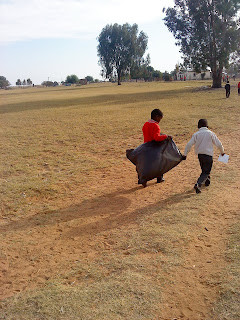
Today, 5 June 2010, is World Environment Day but since I have such a forward-thinking principal, we celebrated it at school yesterday. This time of year is the end of a term, which means the learners are writing exams only, not attending class. They may write 2 exams per day, then can loiter around school or go home. Keeping that in mind, I thought to find some books in the library about energy, conservation, global warming, anything eco- or environmental, and make some lessons.
When I make lessons, they almost always involve drawing; both from me and the learners. They really enjoy it, and it's something I know how to do. So, I put together a short (20-25 minute) lesson on the environment for a smallish group on Thursday. We looked up definitions, including rubbish, littering, recycling, looked at photos of floods, polluting factories, oil spills in the ocean, all sorts of things. After we discussed the issue, I could see some lights coming on inside their heads. They were thinking, and realizing that every action causes a much bigger and pivotal reaction, especially concerning our natural world. It was super! We were lucky to have the available books in our library (Thanks, Northern Cape Provincial Library Services!) but could have done without them if needed. After our lesson, I charged them to make a drawing of something that inspired them about our lesson. There were a few trees, animal and drawings of the world.
The next day, I gave my lesson again to the whole school, and all the kids were really interested. My principal piggybacked off me and reiterated things in Setswana. The note of her lesson was putting ideas into action, not just talking about recycling and making a difference, but DOING. She brought garbage bags from home, and we split up into about 5 groups, and went forth to pick up rubbish from our village. Woo hoo! Talk about exciting. I used to do this in Stillwater, both with the City-wide initiatives and on my own, or with friends. I am very passionate about being a good steward of the environment and educating others to do the same, but the problem seemed so...insurmountable here that I put off dealing with it until now.
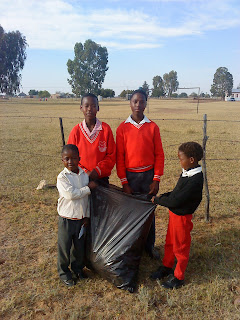

I realize our village will probably be filled with rubbish by the end of the next term, but the point is to make a difference in the life of one person at a time. I know these kids will think twice about throwing their snack wrappers out the bus window now that they have hauled bags of litter back to the school. :)
Wednesday, May 19, 2010
the humanity of sex ed
Remember squirming in your seat in your junior high school health class during the sexual reproductive system lectures? The boys and the girls were separated, and each learning about their own body parts and hormonal changes, as well as those of the opposite sex? Or what about those assemblies in high school where safe sex was discussed, complete with the presenter applying a condom to a banana, with giggles and snickering all around? Embarrassing as the education may have been, at least you received it. Many young people around the world never hear about sex until they are already engaging in it. By then, it is too late to prevent disease, infection or pregnancy. What is a shame is that in the USA, one of the world's most wealthy and developed countries, many students are not receiving proper sex-ed.
Purposefully withholding information from someone is like serving your dinner guests hamburger steak while you feast on a tender cut of fillet; it's not fair, and some might say morally objectionable. Imagine taking a modern world history course in Germany and any mention of the Holocaust has been omitted. Germans have an understandable right to be embarrassed by this shameful part of their history, but does that mean it should be wiped from memory or documentation? Yes, genocide is terrible, as are acts of torture and violence. They are crimes against humanity and probably considered sinful by any major religion which purports human behavior as good or evil. Pretending these activities never happened, however, does justice to no one.
From out of the awful come lessons of learning, forgiveness, tolerance, pain; lessons that might not be learned elsewhere. Lessons we must be taught because, although some find it offensive, each person can decide what to do with the information she receives once she has, in fact, receives it.
Sexual education is a topic which finds controversy from many people and groups worldwide. However embarrassing or morally objectionable it may be for some, each person deserves to know facts surrounding this aspect of health. Denying or only partially educating someone is not fair and ethically questionable. This is especially relevant in the place I stay, South Africa, where 25% of people die from a preventable sexually transmitted disease caused by HIV.
Abstinence-only education, as is practiced in certain areas in the United States, does not make sense for several reasons: 1) it presumes all pupils have the same moral objections to sexually active behavior, prior to marriage, as the design of the curriculum, 2) it purposefully withholds vital health information, and 3) it assumes that risky behavior will disappear if the mention of it is also absent. All of these reasons are irrational, unfair and unsafe.
Sexuality is an integral part of human life, like nutrition, clean water, family, love, and forming relationships with other humans in various aspects. In certain parts of Southern Africa, having multiple partners is common and encouraged according to tribal custom and practice. It stands to reason that there is more chance of spreading sexually transmitted diseases when more body parts are in contact with each other. What is devastating is the lack of knowledge, fear and denial surrounding the epidemic that exists here with HIV and AIDS.
Everybody knows the terms HIV and AIDS, but some people are clueless as to what they really are, how diseases are transmitted and treated, and how to prevent their contraction. Some common myths are that it isn't necessary to use a condom as long as the act is with someone from within one's own ethnic group; you can cure yourself of HIV or AIDS if you have sex with a virgin; if a woman inserts traditional herbs before having sex, she will not contract or spread the disease. A national leader recently became infamous for his comments about showering after sex and how that could reduce his chances of contracting HIV. However, after interviewing a cross-section of young people who live in rural villages in the Northern Cape province, I realize that sex-ed has come a long way in South Africa. It is no longer a taboo among popular culture. One woman in her late 20s said that no one talked about it when she was young, not even in schools, but that she learned from watching television. Advertising campaigns and special television programs have aimed to educate people about the diseases, how to protect themselves, and that they can abstain from having sex as long as they choose. Young people in their early 20s said they began to receive sex-ed starting in grade 7 or 8, and in high school they learned about condoms, safe sex, STDs and HIV/AIDS. An educator in my community says that, although HIV/AIDS is part of the curriculum starting in grade 1, many do not receive an education after grade 7, and people outside of the school are not discussing the issue.
Whether from fear, lack of knowledge, shame, or some other reason, sex is not discussed in rural South African life, although much is being had. Many parents here feel that talking about sex is not their job, their children are too young, or the parents themselves are unaware of certain facts. Healthcare groups who are trained to educate others in rural communities are sometimes actively educating others, sometimes they are not. Most of these people are volunteers, so they are not supervised or held to any recourse for lack of activity. The only momentum for conversation about sex, health and diseases is coming from self-motivated individuals in the community.
I have been fortunate to meet with two young women in the area where stay who are both HIV positive, who encourage others to get tested, declare their status (HIV), who speak at schools and churches and other community events to bravely tell their stories. They are passionate about breaking the silence and busting the myths that surround this deadly disease because they want others to have the chance to protect themselves. They are honest; they tell of their initial apprehension to get tested, their fears, and finally how they are living with HIV. They are gems, serving as leaders in their respective communities.
When facts are not presented clearly, whether about world history or sexual health, many myths and unhealthy practices abound. Blame it on the witches, bad luck, anything but the truth. From a humanitarian point of view, I am excited about the chance to talk openly about sexuality. Regardless if I have a moral objection to the behavior, telling the truth about the consequences of said behavior means more to me than whether or not I think said activities should happen. Any chance I get to help destroy a myth and arm a person with accurate information, so that person can then make an informed decision, truly makes my day. In a way, it is like traditional reference work-finding facts, facilitating education; the big differences are that there is no desk, no posted hours, and this information can save a human life.
Purposefully withholding information from someone is like serving your dinner guests hamburger steak while you feast on a tender cut of fillet; it's not fair, and some might say morally objectionable. Imagine taking a modern world history course in Germany and any mention of the Holocaust has been omitted. Germans have an understandable right to be embarrassed by this shameful part of their history, but does that mean it should be wiped from memory or documentation? Yes, genocide is terrible, as are acts of torture and violence. They are crimes against humanity and probably considered sinful by any major religion which purports human behavior as good or evil. Pretending these activities never happened, however, does justice to no one.
From out of the awful come lessons of learning, forgiveness, tolerance, pain; lessons that might not be learned elsewhere. Lessons we must be taught because, although some find it offensive, each person can decide what to do with the information she receives once she has, in fact, receives it.
Sexual education is a topic which finds controversy from many people and groups worldwide. However embarrassing or morally objectionable it may be for some, each person deserves to know facts surrounding this aspect of health. Denying or only partially educating someone is not fair and ethically questionable. This is especially relevant in the place I stay, South Africa, where 25% of people die from a preventable sexually transmitted disease caused by HIV.
Abstinence-only education, as is practiced in certain areas in the United States, does not make sense for several reasons: 1) it presumes all pupils have the same moral objections to sexually active behavior, prior to marriage, as the design of the curriculum, 2) it purposefully withholds vital health information, and 3) it assumes that risky behavior will disappear if the mention of it is also absent. All of these reasons are irrational, unfair and unsafe.
Sexuality is an integral part of human life, like nutrition, clean water, family, love, and forming relationships with other humans in various aspects. In certain parts of Southern Africa, having multiple partners is common and encouraged according to tribal custom and practice. It stands to reason that there is more chance of spreading sexually transmitted diseases when more body parts are in contact with each other. What is devastating is the lack of knowledge, fear and denial surrounding the epidemic that exists here with HIV and AIDS.
Everybody knows the terms HIV and AIDS, but some people are clueless as to what they really are, how diseases are transmitted and treated, and how to prevent their contraction. Some common myths are that it isn't necessary to use a condom as long as the act is with someone from within one's own ethnic group; you can cure yourself of HIV or AIDS if you have sex with a virgin; if a woman inserts traditional herbs before having sex, she will not contract or spread the disease. A national leader recently became infamous for his comments about showering after sex and how that could reduce his chances of contracting HIV. However, after interviewing a cross-section of young people who live in rural villages in the Northern Cape province, I realize that sex-ed has come a long way in South Africa. It is no longer a taboo among popular culture. One woman in her late 20s said that no one talked about it when she was young, not even in schools, but that she learned from watching television. Advertising campaigns and special television programs have aimed to educate people about the diseases, how to protect themselves, and that they can abstain from having sex as long as they choose. Young people in their early 20s said they began to receive sex-ed starting in grade 7 or 8, and in high school they learned about condoms, safe sex, STDs and HIV/AIDS. An educator in my community says that, although HIV/AIDS is part of the curriculum starting in grade 1, many do not receive an education after grade 7, and people outside of the school are not discussing the issue.
Whether from fear, lack of knowledge, shame, or some other reason, sex is not discussed in rural South African life, although much is being had. Many parents here feel that talking about sex is not their job, their children are too young, or the parents themselves are unaware of certain facts. Healthcare groups who are trained to educate others in rural communities are sometimes actively educating others, sometimes they are not. Most of these people are volunteers, so they are not supervised or held to any recourse for lack of activity. The only momentum for conversation about sex, health and diseases is coming from self-motivated individuals in the community.
I have been fortunate to meet with two young women in the area where stay who are both HIV positive, who encourage others to get tested, declare their status (HIV), who speak at schools and churches and other community events to bravely tell their stories. They are passionate about breaking the silence and busting the myths that surround this deadly disease because they want others to have the chance to protect themselves. They are honest; they tell of their initial apprehension to get tested, their fears, and finally how they are living with HIV. They are gems, serving as leaders in their respective communities.
When facts are not presented clearly, whether about world history or sexual health, many myths and unhealthy practices abound. Blame it on the witches, bad luck, anything but the truth. From a humanitarian point of view, I am excited about the chance to talk openly about sexuality. Regardless if I have a moral objection to the behavior, telling the truth about the consequences of said behavior means more to me than whether or not I think said activities should happen. Any chance I get to help destroy a myth and arm a person with accurate information, so that person can then make an informed decision, truly makes my day. In a way, it is like traditional reference work-finding facts, facilitating education; the big differences are that there is no desk, no posted hours, and this information can save a human life.
Subscribe to:
Posts (Atom)
